
What Is Orton-Gillingham, and How Does It Help Struggling Readers?
Orton-Gillingham is a structured, multisensory approach that meets struggling and dyslexic readers where they are and rebuilds reading from the ground up.

By Samantha
Masters in Education · Certified Orton-Gillingham Specialist
What Orton-Gillingham actually is
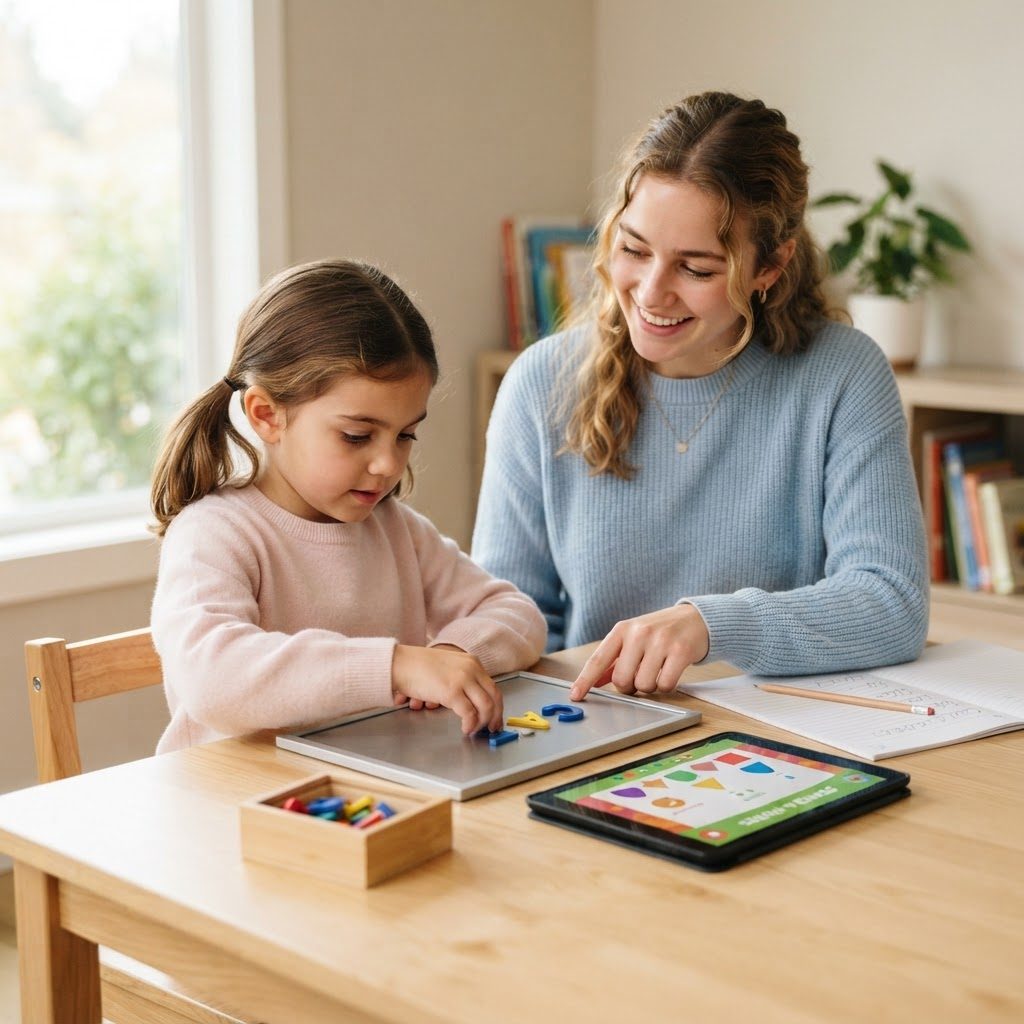
Orton-Gillingham (OG) is a structured, explicit, and multisensory approach to teaching reading, writing, and spelling. It was originally developed to support students with dyslexia, but its methods help any child who struggles to connect letters with sounds. Rather than expecting reading to click through exposure alone, OG breaks the code of written English into clear, sequential steps.
The approach is diagnostic and prescriptive, meaning lessons are tailored to exactly where a student is and adjusted continuously based on how they respond. No two students move at the same pace, and that is by design.
Why the multisensory part matters
In an OG lesson, a student might see a letter, say its sound, and trace it in sand or in the air all at once. Engaging sight, sound, and movement together builds stronger, more durable pathways in the brain than reading off a page alone.
This is especially powerful for students with dyslexia, whose brains often need that extra reinforcement to reliably link a symbol to a sound. Over time, decoding words becomes automatic instead of exhausting.
Structured, sequential, and cumulative
OG follows a careful scope and sequence. Students master one concept before moving to the next, and every new skill builds on what came before. Phonograms, syllable types, and spelling rules are taught directly rather than left for the student to infer.
Phonemic awareness: hearing and manipulating the individual sounds in words
Phonics: connecting those sounds to letters and letter patterns
Fluency: reading accurately and at a comfortable pace
Vocabulary and comprehension: understanding what is read
Signs your child might benefit
If your child avoids reading, guesses at words instead of sounding them out, reverses letters well past the early grades, or reads far below grade level despite being bright and capable, a structured reading intervention can make a real difference. The earlier the support, the faster the progress, though OG helps older students too.
About the author
Samantha
Masters in Education · Certified Orton-Gillingham Specialist
Hi! I’m Samantha, a certified Orton-Gillingham specialist with a Masters in Education. I work with struggling and dyslexic readers using a structured, multisensory approach that builds real, lasting reading skills. I’d love to help your child become a confident reader, schedule a reading intervention session with me today!
Ready for one-on-one support?
Tell us about your student and we will match them with a tutor who fits their subject, personality, and schedule.
Request a Tutor